
The Backlash Is Earned
More than 500 U.S. jurisdictions now restrict or ban new data centers. Seventy-one percent of Americans told Gallup they oppose data centers in their area. New York became the first state to impose a statewide moratorium, a move we wrote about when it happened. Fifty-plus projects were scrapped in 2026 alone, double the prior year’s pace. These are not the numbers of an industry that has successfully communicated its value to the public. They are the numbers of an industry that has, in too many cases, taken what it needed from a community and left the costs behind.
Those costs are specific. When a large data center connects to a shared grid and draws hundreds of megawatts, the infrastructure required to serve it gets paid for across the rate base. Ratepayers who never consented to hosting the facility see their bills go up. Water systems come under stress. Roads absorb construction traffic they were not built for. Housing prices spike when thousands of workers arrive and local residents find themselves priced out of communities their families have lived in for generations. The backlash did not materialize from nowhere. It was built, project by project, over years of operators who treated these tradeoffs as someone else’s problem.
Every Gold Rush Has Its Extractors
Every major infrastructure build in American history has attracted two kinds of operators: those who invest in the communities they enter, and those who extract and move on. The railroad era had both. So did the oil boom, the broadband build-out, and every transformative industrial wave before them. The data center boom, driven by the speed and scale of AI demand, is no different. The concentration of capital, the urgency of the build cycle, and the shortage of viable sites have created exactly the conditions in which extractive behavior is easiest to rationalize and hardest to hold accountable in the short term.
The problem is that the short term ends. Communities that feel taken advantage of do not stay quiet. Regulators who watch utility bills rise for constituents who had no voice in the decision respond. The moratoriums and bans accumulating across the country are the predictable result of an industry that moved fast and assumed the communities hosting it would absorb the costs without consequence.
What We Have Always Believed
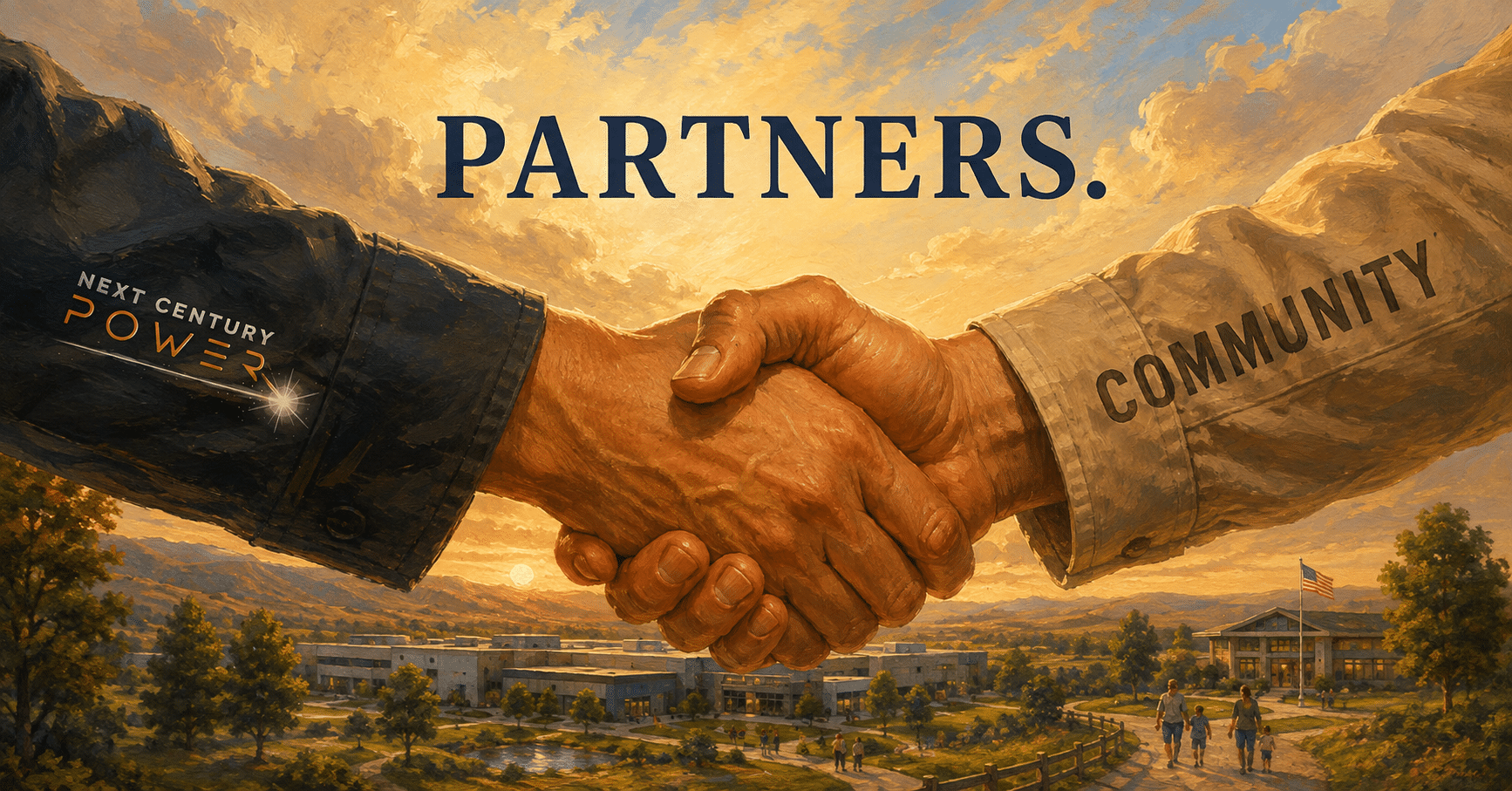
Next Century-Power was built from the start on a different premise: the communities where large-scale AI infrastructure gets built are partners, not hosts to be managed. That is not a response to the current reputational environment. It is a founding principle, and the reason we think about our projects the way we do.
Our facilities are fully islanded. They generate their own power on-site and do not draw from the shared grid during operation. That single fact eliminates the most common source of community grievance: the electricity cost shift. There is no rate increase to explain to a town council because there is no new load on the grid they share. The power plant we bring with us is a local asset, not a new liability on the system. And because our power partnership is designed to last decades, the jobs and tax base it generates are not construction-phase windfalls that peak and fall away. They are long-term contributions to the communities that host us.
Mark Zuckerberg wrote in his letter that Meta keeps electricity prices low by “building our own energy-generating infrastructure wherever we invest.” That is exactly the right instinct. We have been building on it since our founding.
A Step in the Right Direction
Source: Meta launches $1 billion fund supporting data center communities, AL Reporter, August 11, 2026; Meta is giving $1bn to data centre towns. Its proof is a tax from 1968, The Next Web, August 10, 2026; Meta dangles $1 billion fund for ‘customized investments and programs’ in its data center towns, Moneywise / Yahoo Finance, August 10, 2026