
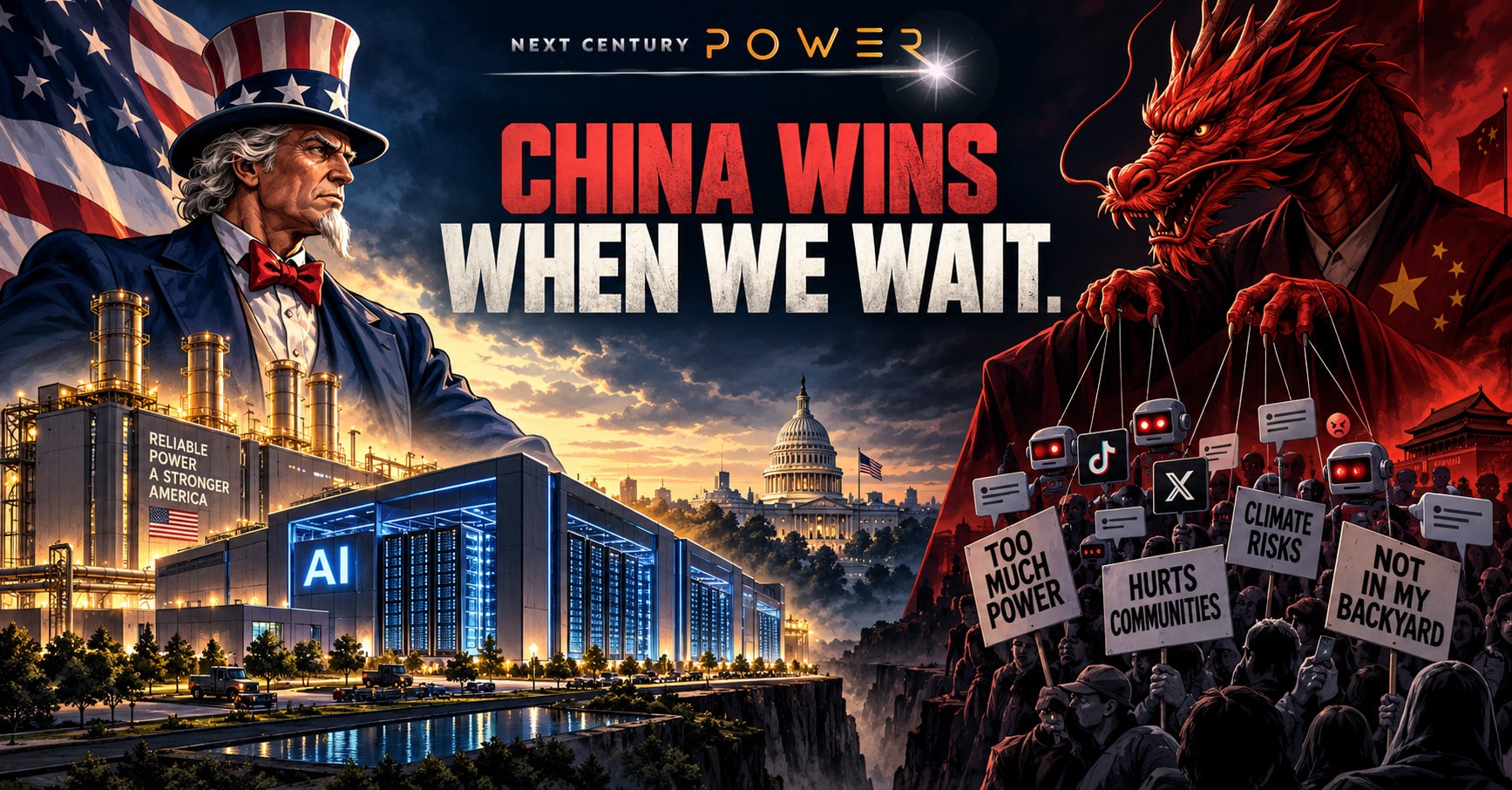
In June, OpenAI disclosed that it had disrupted two Chinese-linked networks that were using ChatGPT to generate anti-data center content. The accounts posed as American residents, posted AI-generated images and commentary about rising electricity costs and grid strain, and targeted the exact conversations happening in city council chambers across the country. In August, X’s safety team identified 200 accounts from a suspected Chinese bot farm posting content designed to manipulate what the platform called “a legitimate debate about American AI and energy policy.” The House Energy and Commerce Committee has asked the FBI and White House science advisors to brief Congress on the full scope of what they know.
The framing in Washington is that this is a foreign influence operation. It is. But the more important statement came from OpenAI’s own head of threat intelligence, Ben Nimmo, who described the campaign plainly: “This was not a case of an influence operation creating a debate. The debate existed already. This was an influence operation from China trying to interfere in it.”
That distinction matters more than the bot farms.
What Is Actually at Stake
The US-China competition in artificial intelligence is, at its core, a competition over compute. The systems that will accelerate drug discovery, compress decades of materials science research into months, model the climate at the resolution where intervention becomes actionable, and build the infrastructure for what researchers describe as artificial general intelligence: all of it runs on data centers. Data centers run on power. A lot of it.
China understands this. It is building its own AI compute capacity at scale, without democratic friction, without local council hearings, and without opposition campaigns in regional newspapers. When China’s influence apparatus posts cartoons of data center operators enriching themselves at the public’s expense and amplifies anxieties about rising electricity bills, it is not making a civic argument. It is executing a strategy. Delay American AI infrastructure by a year, and China gains a year.
The strategy works precisely because the underlying argument is true.
The Industry Built the Argument China Is Amplifying
The opposition to data centers in America is not manufactured. A University of Pennsylvania survey from August found that 61 percent of Americans oppose building new data centers in their area, up 12 percentage points in five months. More than 500 U.S. jurisdictions now restrict or ban new facilities. Seventy-five data center projects worth $130 billion were blocked or delayed in the first quarter of 2026 alone. According to a letter from the House Energy and Commerce Committee, opposition campaigns have delayed or obstructed roughly $45.8 billion in data center projects in Virginia alone.
These numbers reflect a real dynamic. Large data centers connecting to shared grids push infrastructure upgrade costs onto ratepayers who had no voice in the decision. Water systems come under pressure from facilities whose consumption can rival small cities. Communities absorb construction traffic, noise, and land use changes without proportionate economic benefit. The backlash was built project by project, by operators who treated these tradeoffs as someone else’s problem.
Clemson University’s Media Forensics Hub, which tracks foreign influence campaigns online, told NPR it has found little evidence of a coordinated Chinese campaign behind the opposition. “We haven’t found much,” said the lab’s co-lead, Darren Linvill. “I think in this case, the people talking about data centers are real people with real passions and real perspectives and real opinions.”
The most effective influence operation is one that does not need to fabricate its evidence.
The Infrastructure Argument Is Structural
The answer to this is not to dismiss data center opponents as foreign agents. Most of them are not. The answer is to build infrastructure that removes the specific grievances that foreign influence operations are able to exploit.
A facility that generates its own power on-site does not shift electricity costs onto the regional rate base. There is no grid infrastructure bill to socialize across ratepayers who had no say. A facility that brings long-term workforce investment, community benefit agreements, and transparent water use disclosures does not give a bot farm anything credible to post about. The amplification strategy depends on a real grievance to amplify. Remove the grievance and you remove the vector.
Next Century-Power’s model starts at 1GW and above: single-tenant, fully islanded gas turbine generation with on-site carbon capture, and a Phase 2 roadmap to four integrated 300MW small modular reactors. Because our facilities generate their own power and do not connect to the shared grid during operation, the cost shift that sits at the center of the industry’s reputational problem does not exist. There is no interconnection cost to socialize. There is no utility infrastructure build-out to charge to ratepayers. The facility is, structurally, not a grid load.
AGI will not be built in a country that cannot build the physical infrastructure to support it. The compute required to model complex systems at the resolution where intervention becomes possible, to accelerate the discovery of medicines that affect billions of people, to compress scientific progress that currently takes decades into timeframes that are actually useful: that compute has to run somewhere, and it has to be powered somehow. If the power model being deployed generates legitimate grievances in real communities, those grievances become available for amplification by anyone with a reason to want American AI development to slow down. The problem, in that case, is not the bots. The problem is the model.