
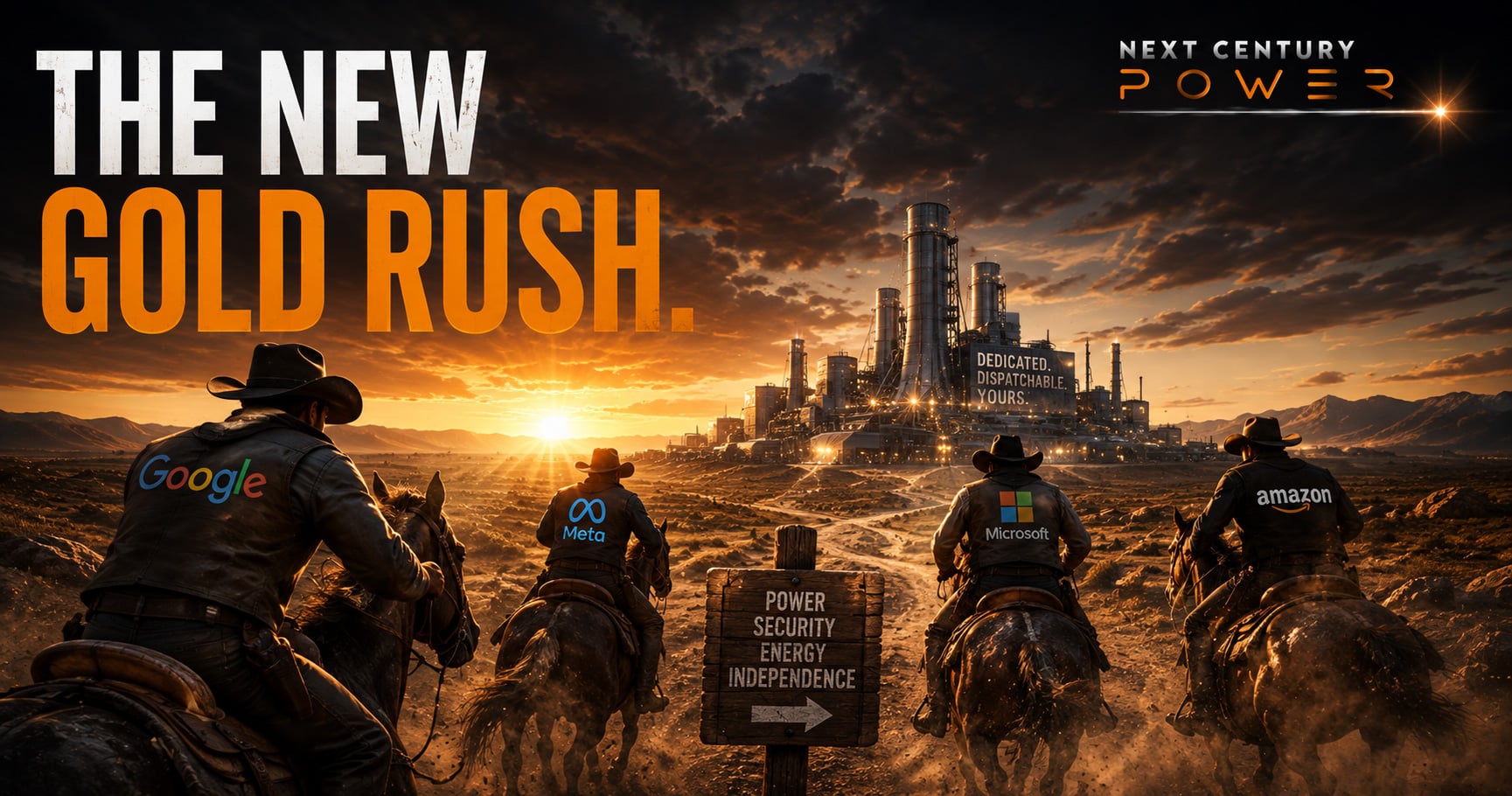
The End of the PPA Era
For two decades, the standard hyperscaler approach to power was the corporate power purchase agreement. Companies contracted with renewable developers, logged the renewable energy credits, and continued drawing from a shared grid. The model worked when data centers were measured in tens of megawatts. It stopped working at the scale AI infrastructure requires.
Intersect CEO Sheldon Kimber described what replaced it in terms that could not be more direct. The acquisition, he said, was “the logical extension” of the Google partnership, and he argued that AI development had been “hindered by the U.S. electric power industry.” The market, in his framing, had moved to a “bring your own generation” framework. Google’s global head of data center energy, Amanda Peterson Corio, described the strategy the same way: “We’re looking at siting next to power generation and creating these industrial parks.”
Google is not alone in reaching this conclusion. Meta is building three on-site natural gas plants costing $3 billion for its 5 GW Hyperion facility in Louisiana. Microsoft signed a 10.5 GW deal with Brookfield Asset Management to control its own supply. Amazon is pursuing nuclear via Talen Energy. These are not companies that are still waiting for utilities to solve the problem. They are companies that have concluded the problem will not be solved by utilities on a timeline that matches their infrastructure build-out.
What Google's Energy Park Model Is — and Is Not
The Meitner Energy Center represents a specific architecture worth understanding precisely. Google describes it as co-location: the data center comes online alongside dedicated power generation, reducing the need for new supply on the local grid. The facility is still connected at the substation level. The majority of its power comes from wind and solar, which are intermittent resources, firmed by on-site gas generation to ensure reliability. That firming requirement is not a minor detail: it is the reason gas generation is present at all in a project Google is positioning as primarily clean energy.
The model is a genuine improvement over waiting years in a grid interconnection queue. It is not the same as fully islanded generation. The Meitner facility draws from the grid when needed and contributes to the shared system when generation exceeds load. The operational risks and policy exposures of grid connection, though reduced, are not eliminated.
A Different Architecture
Next Century-Power was built on the same thesis Sheldon Kimber articulated when he described why Google bought Intersect. The difference is in the architecture we execute.
Our Phase 1 model is 1 GW and above of gas turbine generation in fully islanded, single-tenant configurations. That is base-load, dispatchable capacity. It does not require firming from a separate fuel source, because it is the base. Four-nines uptime is a design specification, not an aspiration. On-site carbon capture processes emissions into high-value 2D materials, addressing the sustainability question that behind-the-meter turbine deployments typically leave open. And because our facilities are fully islanded, they carry no grid exposure during operation: no PJM capacity market obligation, no NERC curtailment exposure, no shared-grid operational risk of any kind.
The scale is also different. Google’s Meitner campus is a 1 GW co-located complex. NCP’s Phase 1 deployments start at 1 GW and are designed for a single tenant. The operator gets the full capacity of a dedicated power plant without sharing it with a grid or competing with adjacent load.
Phase 2 is a 1.2 GW pod of four 300 MW small modular reactors. Google is pursuing nuclear via PPAs with Kairos Power. NCP’s Phase 2 roadmap brings that nuclear trajectory inside the fence line of the facility it powers, under the same managed power partnership that begins with first gas turbine energization.
The “bring your own generation” era Kimber described is now the operational consensus among the companies with the resources to act on it. What is being worked out across every one of these projects is what “your own generation” actually means in practice: whether it is grid-connected but majority on-site, or fully islanded; whether it relies on intermittent resources with gas backup, or on dispatchable base-load capacity; and what the trajectory toward decarbonization looks like at decade-scale contract horizons. These are not small distinctions. They determine what a facility’s power future looks like for the thirty years after the first circuit closes.