

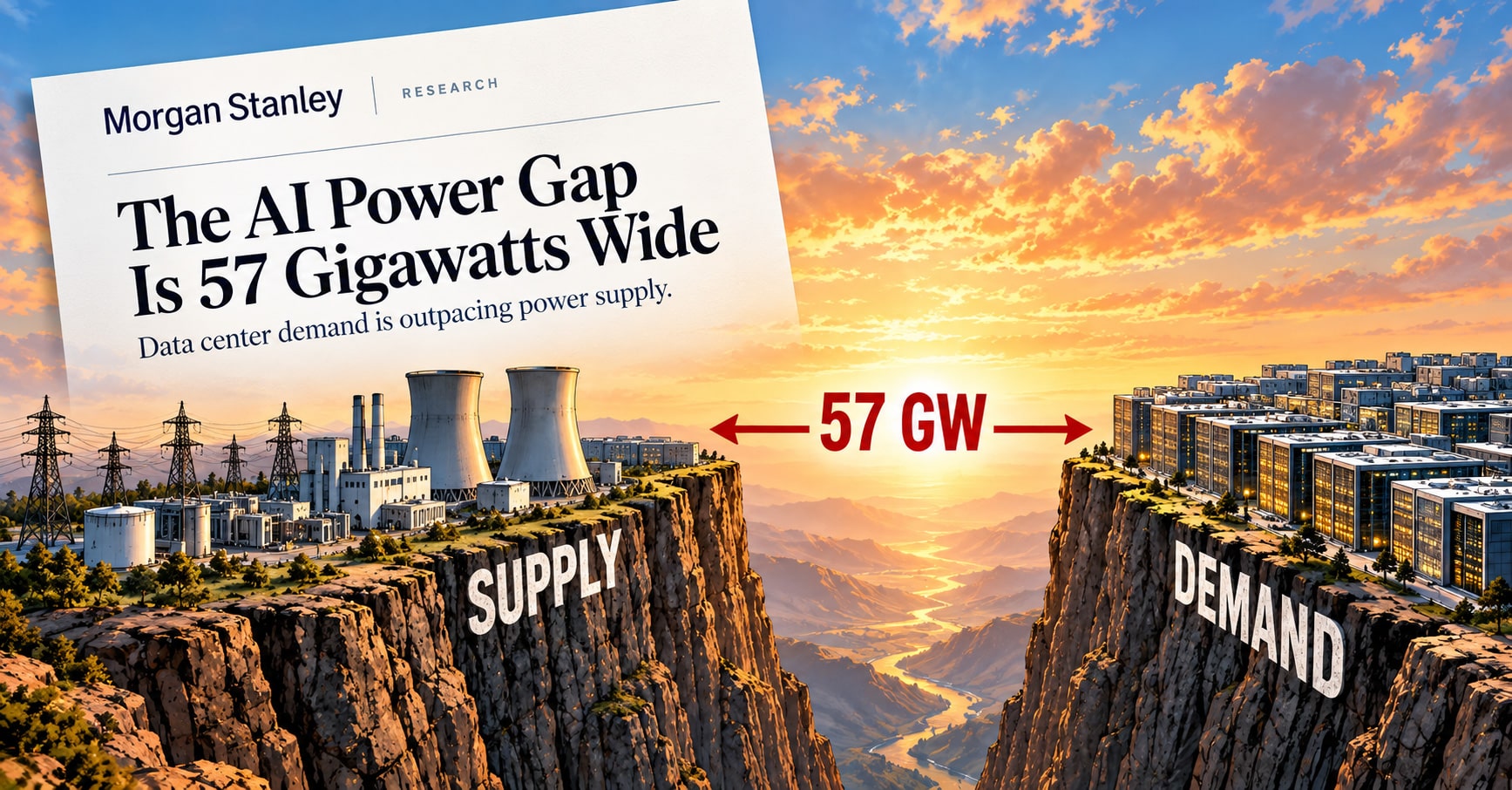
Morgan Stanley published research this month estimating U.S. data center power demand will rise from 9.19 gigawatts in 2025 to 78.57 gigawatts by 2029. That is a 755 percent increase in four years. Against that demand curve, the firm projects data centers under construction represent about 21 gigawatts of new capacity, and available grid connections cover roughly another 19. That leaves a projected 57-gigawatt shortfall before 2029. Even accounting for alternative supplies, including onsite natural gas generation, fuel cells, and nuclear-adjacent projects, Morgan Stanley estimates about 33 gigawatts remain uncovered through 2028.
24/7 Wall Street published the analysis this morning under the headline “The Coming AI Blackout.” The framing is financial: which companies benefit when megawatts become the new GPUs. The underlying dynamic is structural: for the first time in the AI buildout cycle, power supply is the binding constraint, not chip supply.
The Efficiency Trap
The most counterintuitive finding in Morgan Stanley’s research is that chip efficiency improvements make the power problem worse, not better.
The intuition is that faster chips lower the electricity cost of producing each AI token. The reality is that cheaper tokens drive higher volume. Morgan Stanley estimates tokens generated per watt could rise nearly sixfold between 2025 and 2028, and electricity consumption keeps climbing anyway. Newer hardware compounds this: the firm estimates an Nvidia Vera Rubin rack at roughly 234 kilowatts, with a future Rubin Ultra configuration approaching 600 kilowatts per rack. As efficiency rises at the chip level, it arrives packaged in denser racks that draw more power per square foot than the generation they replace.
The article’s conclusion is blunt: “AI’s biggest problem is evolving from getting enough GPUs to getting enough megawatts.” The efficiency narrative was always a bit optimistic. The math just doesn’t run in the expected direction.
What the Market Is Already Building
When hyperscalers can no longer assume the grid will provide power on their timeline, they go around the grid. That process is already underway. Enverus Intelligence Research projects 29.6 gigawatts of behind-the-meter gas generation added by 2030, with data centers accounting for 88 percent of that capacity. Reuters reports that developers are already sourcing smaller onsite gas turbines specifically because they can be deployed faster than grid-connected generation.
Behind-the-meter is not a new concept. What is new is the scale and urgency. A 1GW+ facility cannot be served by a rooftop solar arrangement or a diesel backup generator. It requires dedicated, purpose-built generation infrastructure that can sustain continuous high-performance computing load under a long-term contractual structure.
The grid cannot be rebuilt at AI speed. Transmission infrastructure takes five to ten years to plan, permit, and energize. Data centers build in eighteen to thirty-six months. The gap between those timelines is not closing; it is widening. Every year the interconnection queue grows and every year the power density of new AI hardware increases, the case for on-site generation becomes more straightforward.
Next Century-Power’s Phase 1 model is a 1GW+ islanded gas turbine microgrid, single-tenant, with on-site carbon capture. It is the operator-scale version of exactly what the market is moving toward, sized for the facilities that actually move the needle on U.S. AI compute capacity. Phase 2 transitions that load to an integrated pod of four 300MW small modular reactors, locking in cost-stable, durable power for the decade horizon that serious AI infrastructure investments require. The Enverus forecast puts 29.6 gigawatts of behind-the-meter gas capacity on track for 2030. The question for any data center developer evaluating that market is who builds and operates that generation at scale, with the reliability requirements, the contractual structure, and the transition roadmap that a mission-critical AI facility demands. That is a different question than whether behind-the-meter generation is the right direction. Wall Street answered that question this week.