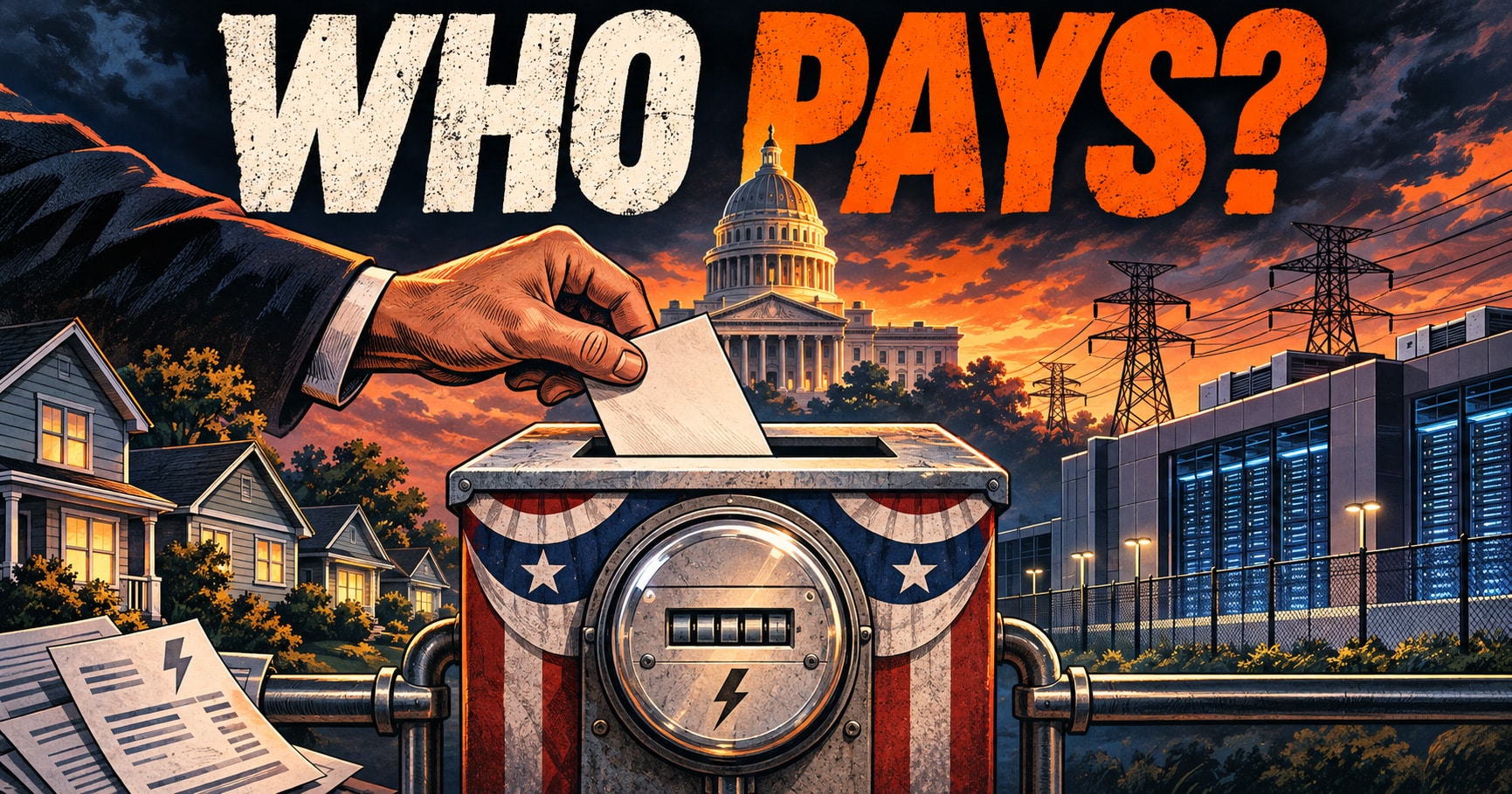


At the BloombergNEF Summit in Houston this week, Noelle Walsh, Microsoft’s president of cloud operations and innovation, made a pledge that would have sounded unnecessary three years ago. Microsoft intends to power its data centers without government subsidies and without raising costs for other electricity customers. In her words: “We will pay our own way.”
The pledge did not come out of nowhere. In the same stretch of days, Indianapolis pushed back on $113 million in tax incentives for a data center, a Kansas city approved a 10-year moratorium on new ones, and an analyst report found that more than half of U.S. hyperscale projects now face regulatory friction after the midterms. The largest buyers of electricity in the country have noticed that their neighbors are reading their utility bills.
So the instinct is right. It is also harder to deliver than it sounds.
The trouble with paying your own way on a shared system
A data center that connects to a utility does not buy a discrete slice of power. It buys access to a shared system: transmission lines, substations, reserve margins, and generation that every other customer depends on. Even when a large customer pays the full tariff rate, the cost of expanding that system can end up in a rate base that everyone pays into. Good intentions do not change the accounting. Only the tariff design does, and the tariff design is still being argued.
Regulators are working on it. In June, FERC ordered all six regional grid operators to justify or rewrite their rules for connecting large loads. Those responses are due Monday. PJM, the country’s largest grid operator, already had most of its own large-load plan rejected in October. More than a year after the Department of Energy told FERC to act, the industry is still at the filing stage.
Meanwhile, the grid is asking for more from the customers it already has. At the same Houston conference, ERCOT’s chief executive said he will ask the Texas legislature for authority to make data centers cut power before an emergency is even declared. A customer can pay its own way in full and still be first in line to be switched off.
What the pledge actually requires
There is one structure where the accounting is simple. The data center generates its own power, on its own site, with its own capital. No shared transmission upgrades. No reserve margin borrowed from the neighbors. No hearing in front of a utility commission about who owes whom.
The companies with the most compute to build are already moving this way. This week Anthropic signed a $3.4 billion gas generator deal to support 1.7 gigawatts of data center power. Google’s first Wyoming data center, a $17 billion investment, comes paired with a planned 702-megawatt fuel-cell development with carbon capture and storage. Neither announcement mentions waiting on an interconnection queue.
Taken together, the week reads like a pattern. The pledge is to stay off the ratepayer’s bill. The practice is to put the generation next to the servers.
Paying your own way, literally
This is the model Next Century-Power was built on. We develop and operate dedicated, single-tenant power for large data centers: gas turbine microgrids at one gigawatt and above, islanded from the grid, designed for four-nines uptime and contracted over ten years or more. Emissions are captured on site and processed into high-value 2D materials, and the long-term path runs to a 1.2-gigawatt pod of four small modular reactors.
In that configuration, a tenant’s power costs are its own by construction. Nothing is socialized, because there is nothing shared to socialize. Nobody upstream can curtail it, because there is no upstream. And it arrives on a construction schedule, not a queue position.
Microsoft deserves credit for saying the quiet part clearly. The public’s patience for subsidizing AI’s power bill is running out, and the hyperscalers know it. But a promise made on a shared grid depends on tariffs, regulators, and grid operators that the promiser does not control. The surest way to keep your costs off other people’s bills is to not be on their system in the first place.