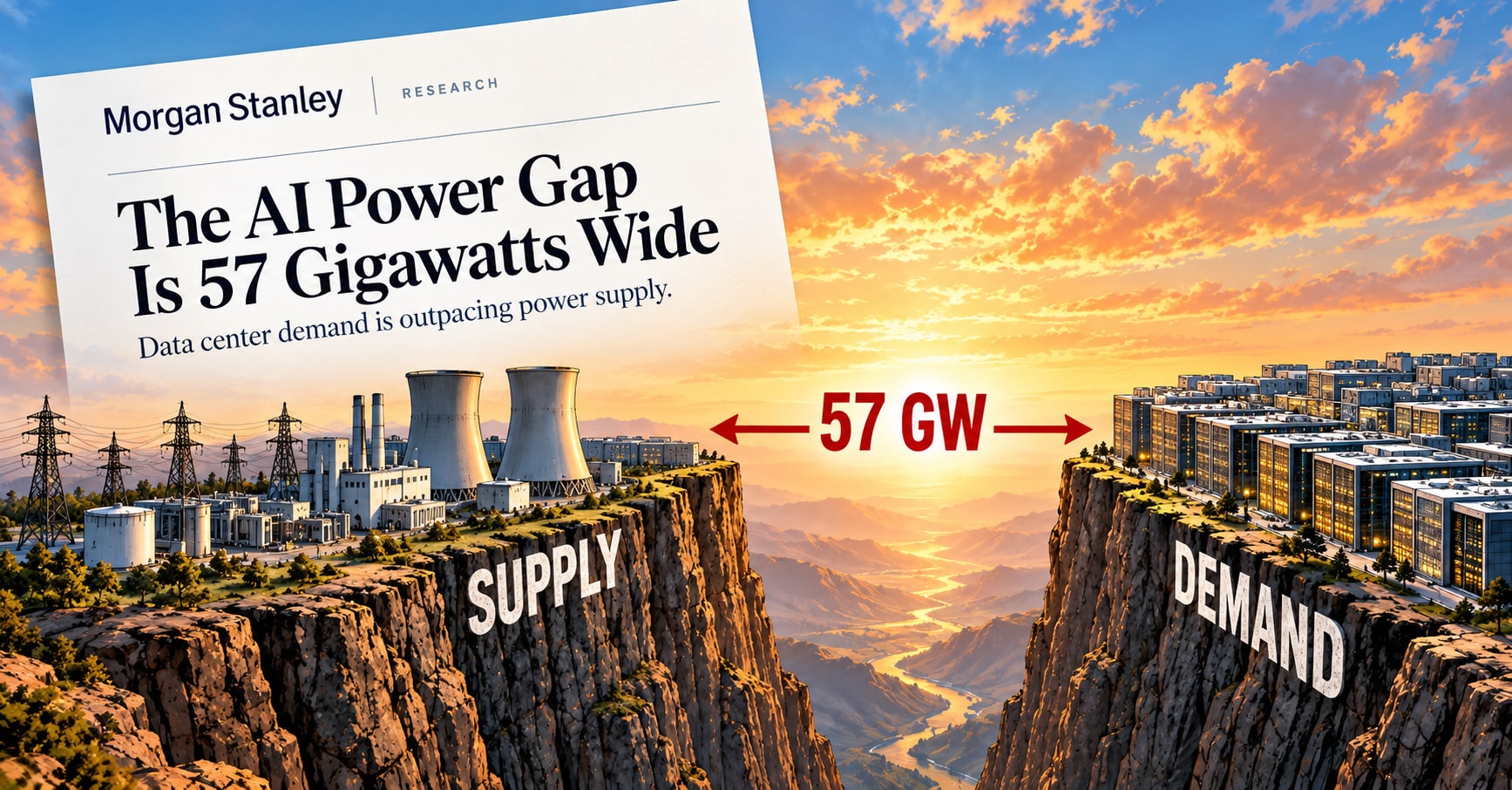


Goldman Sachs published a report this week projecting global data center power demand will surge 170 percent between 2025 and 2030, with more than 60 percent of that growth coming from the United States. The bank’s global head of digital infrastructure investment banking put it plainly: “Power is probably the forever bottleneck.”
Not chips. Not models. Not talent. Power.
The framing matters because it marks a shift in how Wall Street is categorizing AI infrastructure risk. The AI race has been defined by compute, by who has the most H100s, by who can train the next frontier model. Goldman is now arguing the binding constraint is upstream of all of that, and it has been for some time.
What 2,600 Gigawatts in a Queue Actually Means
The U.S. currently has roughly 2,600 gigawatts of proposed power generation and storage projects waiting for grid connections. That is more than twice the grid’s total installed capacity. The median time from submitting a connection application to commercial operation is approximately five years.
That number deserves to sit for a moment. A data center developer who applies for a grid connection today, assuming their project survives the queue, could be looking at power delivery in 2031 at the earliest. Goldman notes 86 projects have already been canceled or significantly delayed since January, 76 of them due to local opposition. The projects that survive the queue still have to survive the permitting and community approval process.
Goldman projects $7.6 trillion in capital spending across computing, data centers, and power infrastructure between 2026 and 2031. Much of it is being financed with debt: $420 billion in hyperscaler debt issuance expected in 2027 alone, up more than 60 percent from 2026. Roughly 35 percent of hyperscaler capital expenditures next year will be debt-financed. The report notes this raises the stakes considerably if construction timelines slip.
The Risk Nobody Is Pricing Correctly
Goldman’s warning is specifically about the mismatch between capital commitment and power availability. Companies are borrowing against AI infrastructure buildout timelines that assume power arrives on schedule. The grid is not built to deliver on those assumptions.
Tech giants have recognized this. The report notes they are increasingly considering arrangements to directly fund power generation, transmission lines, and electrical infrastructure their data centers require. The utilities are following: utility capital plans are projected to reach $1.3 trillion between 2026 and 2030. But utility infrastructure
timelines run on the same five-to-ten-year horizon as the interconnection queue. Announcing a utility investment in 2026 does not produce electrons in 2027.
The practical consequence is that a significant portion of the $7.6 trillion Goldman tracks is being committed before the power to run it is secured. “Power is probably the forever bottleneck” is not a forecast about the distant future. It describes the situation today.
A Different Calculation
For developers who cannot afford to wait five years for a grid connection, or who are financing construction with debt and cannot absorb timeline slippage, the math on dedicated on-site generation looks different than it did two years ago. Next Century-Power’s Phase 1 model, a 1GW+ islanded gas turbine microgrid in single-tenant configuration, delivers power on the timeline data center construction requires rather than the timeline the interconnection queue allows. Phase 2 transitions that generation to an integrated pod of four 300MW small modular reactors, securing cost-stable power across the decade horizon that Goldman’s $7.6 trillion capital figure implies. Goldman named the bottleneck. The question for any developer working against a debt-financed timeline is whether they are building a plan around it or around the assumption that the grid will show up on time.