
Our co-founder Terry Ploetz on Hello Future with Kevin Cirilli.
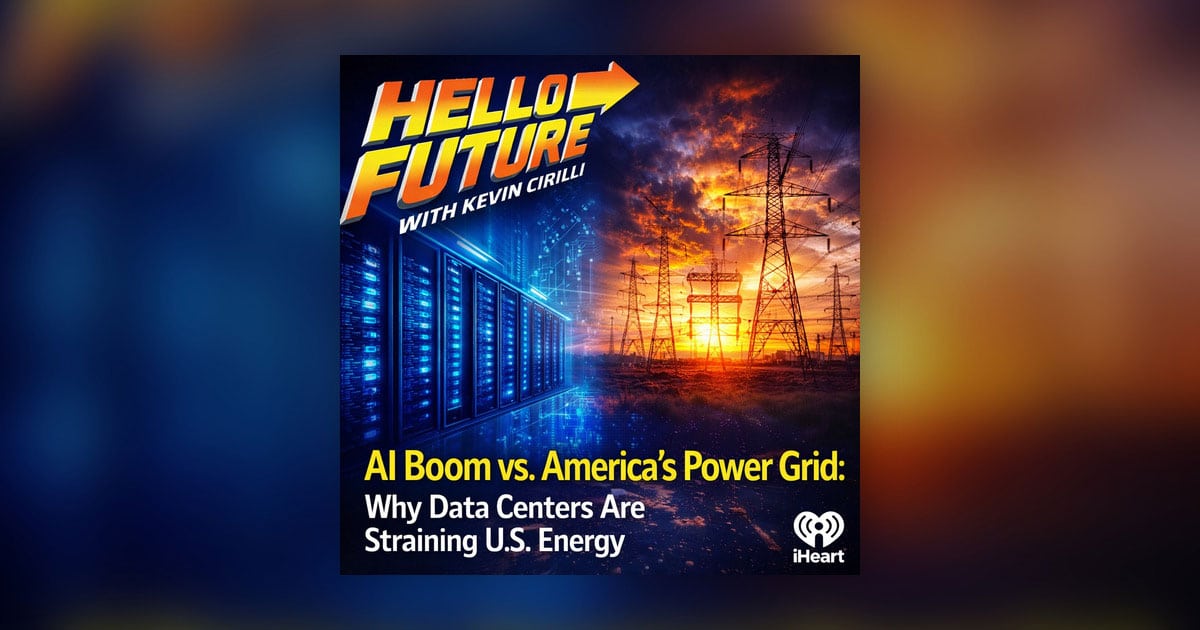
Last week, our co-founder Terry Ploetz sat down with Kevin Cirilli on Hello Future, the daily iHeartRadio podcast and dispatch from “the digital frontier.” We’re grateful for the invitation, and we’re grateful for the seriousness with which Kevin took the topic. There aren’t many shows willing to look at the AI energy story with both clear eyes and an open mind. Hello Future is one of them.
If you’d rather listen than read, the full episode is here: Hello Future: AI Boom vs. America’s Power Grid. It’s about twenty minutes, and it might change how you think about your next utility bill.
What follows is the case Terry made on the show, why it matters, and what comes next.
The diagnosis
Kevin opened with the question every American is starting to ask in some form: are we going to have enough energy to win the geopolitical race for AI without crushing the people paying the electric bill?
Terry didn’t dodge.
That’s not pessimism. It’s arithmetic.
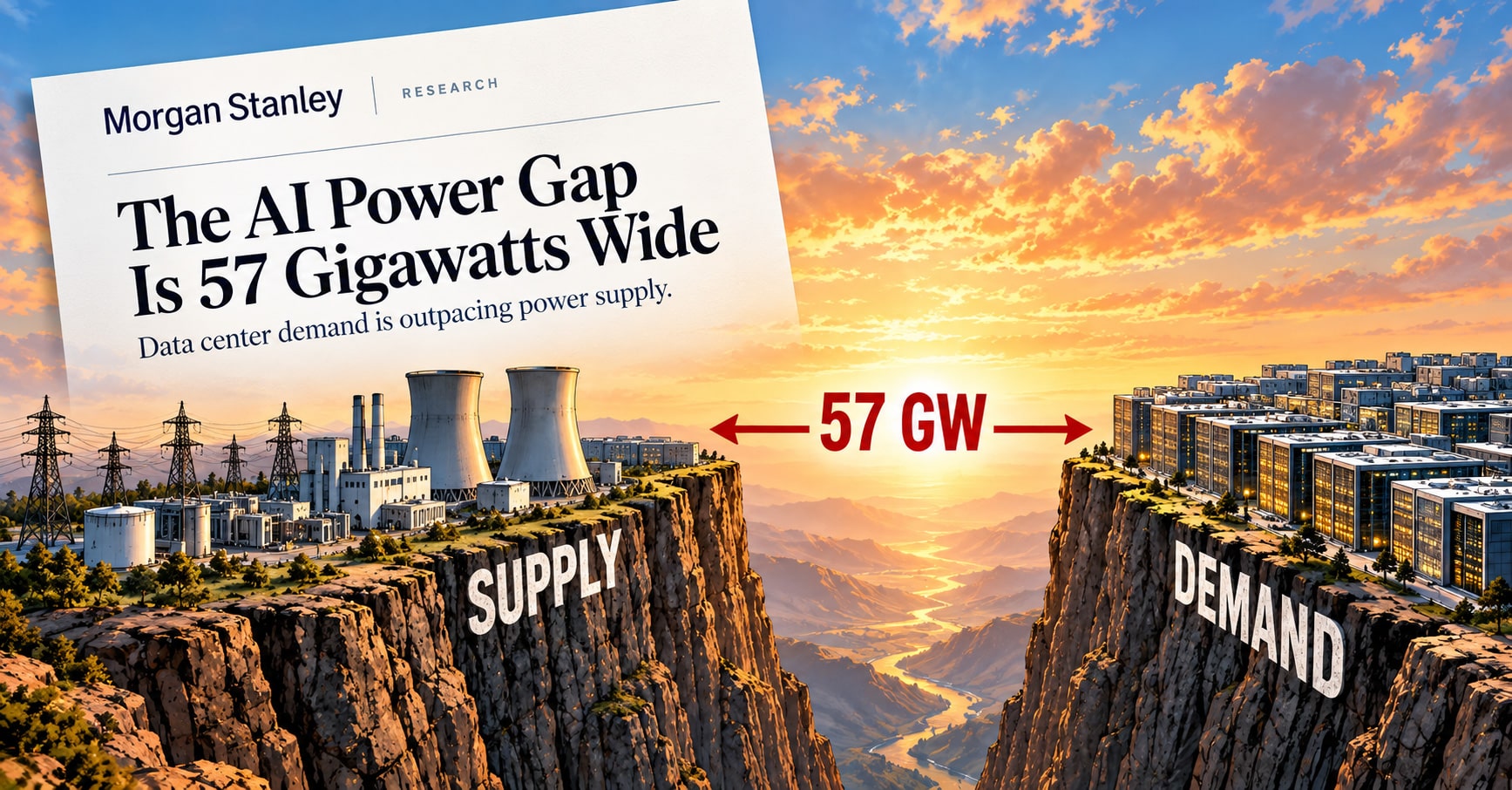
Seven trillion dollars are expected to flow into AI infrastructure between now and 2034. Hyperscalers are asking utilities for power, and utilities are quoting them 2032 or 2035. National average residential rates are climbing toward 20 cents per kilowatt-hour. On the East Coast, they’ve already passed 24. PJM has indicated that capacity prices may need to rise as much as 800% to upgrade the current grid for projected demand, which is the kind of pressure that flows through to residential bills in real ways. That’s how a $200 monthly bill becomes a $600 monthly bill in a state like New Jersey.
And that’s before you look at the infrastructure beneath it. Seventy percent of America’s power plants are operating past their 25-year useful life. Major distribution lines are over 50 years old. The legal frameworks governing how utilities operate were written more than a hundred years ago, before the personal computer existed, let alone large language models. There are roughly 3,000 utility companies in North America, each working as hard as they can independently, with no single federal authority coordinating capacity at the scale this moment requires.
This is the system being asked to absorb the largest industrial buildout of our lifetimes.
What we appreciated most
Kevin called it out directly on the air: a real sense of realism, and not blaming people.
There are people in this conversation who want to blame the hyperscalers. There are people who want to blame the utilities. There are people who want to blame AI itself.
Terry doesn’t.
The race to AI is a path toward better cancer treatment, better food security, cleaner water, and the kind of economic competitiveness this country needs. Walking away from it would be a generational mistake. The hyperscalers are doing what hyperscalers do. The utilities are doing the best they can with assets two and three decades older than they should be, regulated by frameworks written for an era that ended a long time ago.
The honest answer is that the system is operating exactly as it was designed to operate. The problem is that the design is outdated.
A meteor and the lifeboats
Terry put it this way on the show, with a metaphor Kevin had to clarify on air:
Grid 2 isn’t a hypothesis at Next Century Power. It’s the model we build.
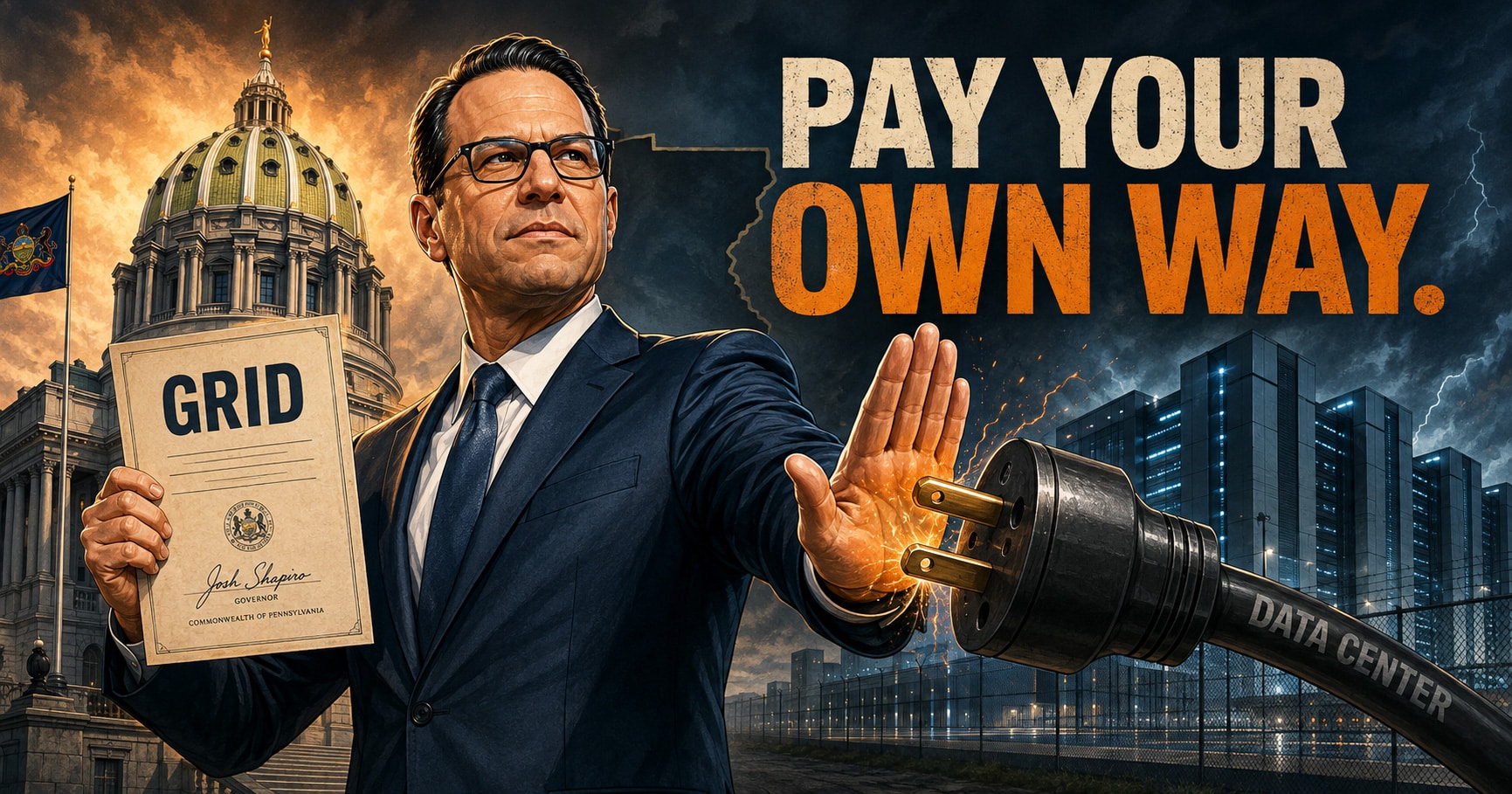
Take the data centers off the public grid entirely. Site dedicated, behind-the-meter natural gas microgrids next to them. Power the hyperscaler directly, without a single watt running through the public utility, and without a single dollar of cost shifted onto a residential ratepayer’s bill.
Behind the meter, in plain English: the data center is not on your utility bill. It cannot be. Your utility company is not involved. Even if one of these facilities is sited next door to your home, your rate is unaffected by it.
That’s the floor of what we offer. The ceiling is better.
What gets built into every site
Our standard project is a 1.3-gigawatt baseload plant on roughly 650 acres. One gigawatt goes to the hyperscaler. The remaining 225 megawatts, enough to run a city the size of South Bend or Hoboken, is built in for redundancy. AI workloads cannot tolerate more than five seconds of downtime, so we overbuild the plant to guarantee it. In normal operation the redundancy load runs at six to ten percent. The other 90 percent is surplus capacity, available to do something useful for the place where we built it.
That surplus goes back to the local utility at cost. New supply on the local grid means downward pressure on local rates. Basic economics. It also frees the utility to invest in itself and its customers, instead of scrambling to keep up with a load that wasn’t its job to absorb in the first place.
We engineer the rest of the site for the people who live near it.
Dry cooling and closed-loop systems push water consumption far below the industry norm. Silencers and noise barriers bring turbine noise down to 65 decibels at the property line, which is roughly the sound of a normal conversation three feet away. Carbon capture turns the emissions into a product: carbon nanotubes, carbon nanofibers, and graphene, the 2D materials that are increasingly the backbone of advanced manufacturing, defense applications, and clean-tech components.
That last piece is what changes the jobs picture. A typical hyperscale data center employs around twenty operators after construction. Our model, because it includes carbon capture and 2D materials manufacturing on site, employs hundreds of people on an ongoing basis. Blue-collar, technical, higher paying.
Terry put a finer point on it:
Community benefit, not community burden
Every 1.3-gigawatt project of ours comes with a Community Benefit Agreement, a legally binding contract between the developer and the host municipality. Our standard CBA returns $50 million to that community for them to spend however they choose. In some places, that could fund a property tax holiday. In others, it could underwrite residents’ utility bills. In others, it pays for the roads, water mains, schools, and broadband those counties have been waiting on for decades.
Our facilities are developer-funded. We do not require government aid or tax incentives to make the math work. As a power producer rather than a regulated utility, we pay taxes into the communities where we operate. We do not take incentives out of them.
We build for cyber resilience too. Our microgrids are air-gapped, with monitoring data flowing through blockchain protocols so neighboring pipelines and operators stay informed without exposing our control surfaces to the open internet. As Terry noted on the show, scale that to 100 or 1,000 facilities and you have built something genuinely defensible at the national level.
Why this conversation matters
Kevin asked, in a tone that wasn’t quite resigned but wasn’t optimistic either, why no one in Washington seems to be taking a big swing on this. We don’t have a complete answer. What we know is that the conversation in too many capitals is still framed as if AI demand is a threat to manage rather than a national asset to channel. It is both, of course. The work is in deciding which framing wins.
We are betting on the second one.
We are not anti-grid. We are not anti-utility. We are certainly not anti-AI. We are anti-status-quo, because the status quo, as currently engineered, asks rural communities and residential ratepayers to bear the cost of an industrial transformation they did not vote for and will not benefit from in proportion to what they pay. That outcome is not inevitable. It is a choice. And there is a different choice on the table.
We were honored to make that case on Hello Future. Thank you, Kevin, for the platform and the seriousness you brought to the topic. We would love to come back.
If you want the long version of how our model works, our team is happy to walk through it. If you want the short version, it’s the line Terry used on the show, and the line we will be using for a long time.
Listen to the full episode: Hello Future: AI Boom vs. America’s Power Grid
Read Kevin Cirilli’s accompanying decision-maker brief at mtf.tv: Future-Proofing AI Infrastructure Without Raising Electric Bills