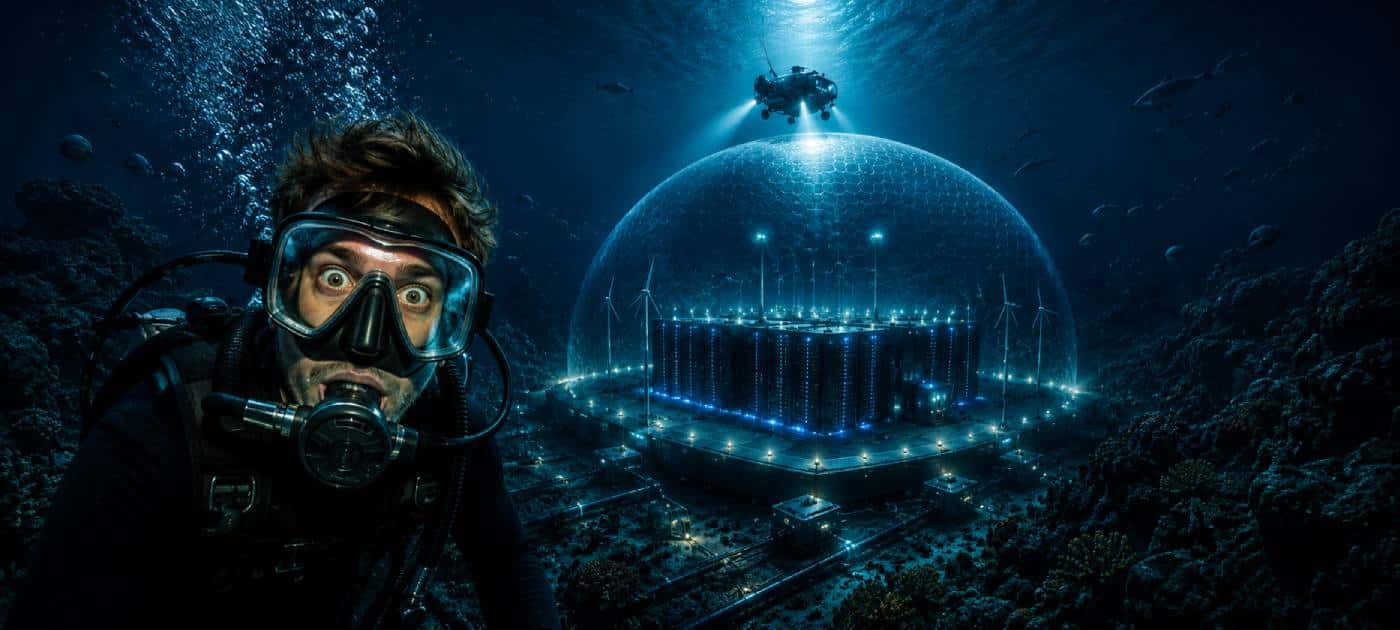
This week’s big AI infrastructure headline came from the bottom of the ocean. According to a new report from Scientific American, China is pulling ahead of the rest of the world in sinking data centers off its coast — and the early results are striking. A commercial undersea facility off Shanghai, operated by Hailanyun, is reportedly using at least 30% less electricity than a comparable land-based data center, simply by piping seawater past server racks instead of running energy-intensive chillers. The company went from a pilot project in Hainan in late 2022 to commercial deployment in under 30 months — faster than Microsoft ever moved with its own undersea experiment, Project Natick. South Korea is now exploring similar projects, and Japan and Singapore are looking at data centers that float on the surface rather than sink beneath it.
It’s a genuinely clever piece of engineering. Cooling alone can account for roughly 40% of a typical data center’s electricity use — most of it spent chilling water that’s sprayed or evaporated to pull heat off the servers. If the ocean can do that job for free, that’s a real win for efficiency, and it’s no surprise the idea is spreading fast.
The part the headlines skip
Here’s the thing: shaving 30% off the cooling bill doesn’t change the fundamental math facing every AI data center operator today. These facilities still need enormous, reliable, always-on electricity — and demand is growing faster than grids can keep up. Whether a server rack sits in a Virginia industrial park, floats off the coast of Singapore, or sits on the seafloor near Shanghai, it still needs megawatts (and increasingly, gigawatts) of power delivered on day one, with the reliability to keep it running every day after that.
Undersea data centers solve a real problem — heat rejection — but they don’t solve the problem: getting enough power to the site, fast enough, without waiting years for grid interconnection queues that are already backed up across most major markets.
Where Next Century-Power comes in
That’s the gap we built our company to close. Our model is Speed to Power: we develop and operate dedicated, on-site, independent generation for large data centers — starting with large-scale gas turbine microgrids that can come online in a fraction of the time a new grid connection takes, with four-nines reliability and built-in redundancy. From there, we help sites transition to our long-term core product: a 1.2GW pod system built from four integrated 300MW SMRs, paired with carbon capture technology that supports net-zero goals without slowing down deployment.
The undersea data center trend is a good reminder of where the industry’s attention is headed — and a good validation of our thesis. Operators are willing to rethink everything, including where a data center physically lives, in pursuit of efficiency gains in the 20-30% range. Imagine what’s possible when the power itself — not just the cooling — is purpose-built for the site, available faster, and structured for a decade or more of price stability.
So bravo to the engineers thinking outside the bubble on cooling. At Next Century-Power, we’re focused on the piece that determines whether any of these projects — undersea, floating, or firmly on land — can get built at all: the power behind them.
Ready to talk about power for your next site? Let’s chat.
Source: China Powers AI Boom with Undersea Data Centers, Scientific American