
Why 20 Megawatts
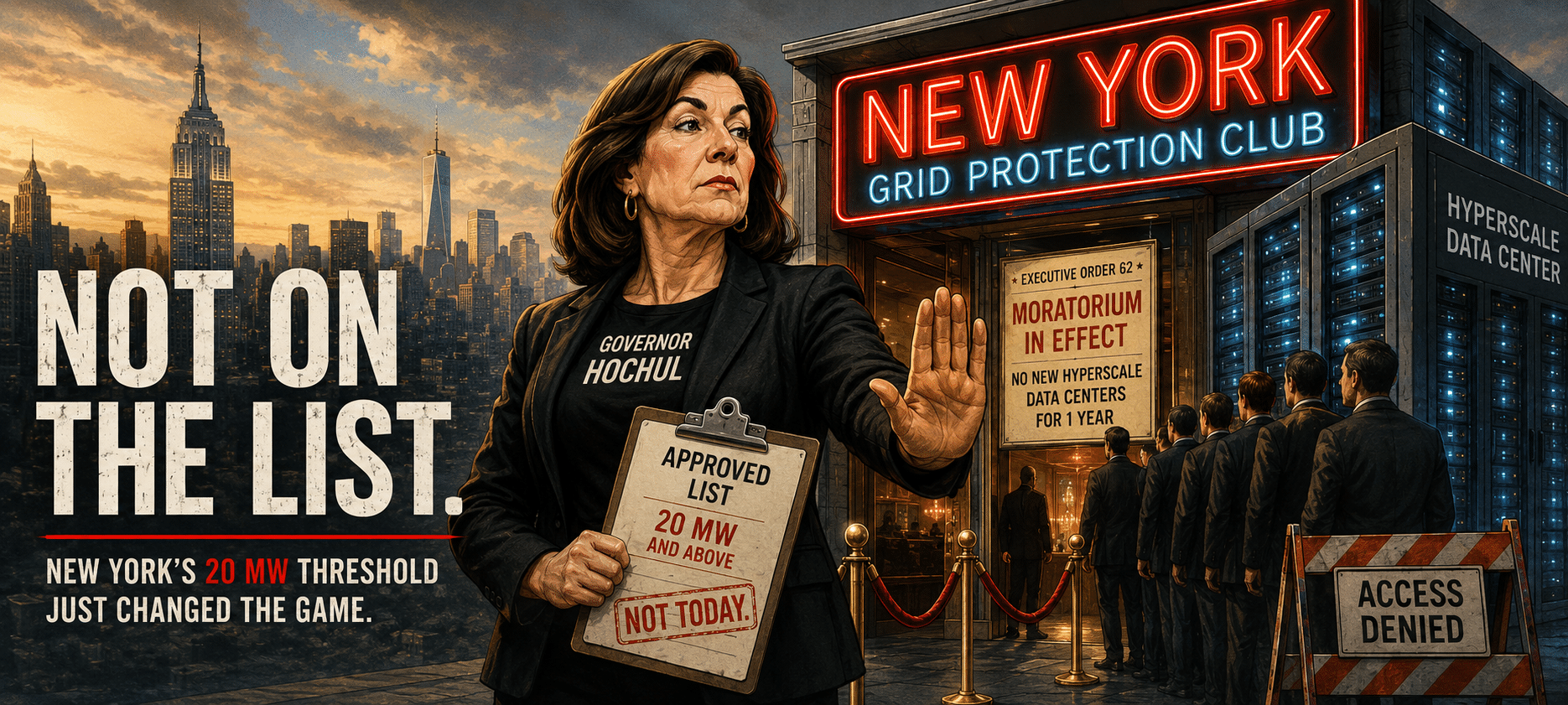
The moratorium applies to data centers with peak demand of 20 megawatts or more. The legislature did not pick that number by accident. The underlying legislation, the Responsible Data Center Development Act, is structured around three demand thresholds: 1 MW, 5 MW, and 20 MW. Only the 20 MW threshold triggers the DEC permitting freeze. The smaller tiers face renewable energy mandates and labor requirements, but they can still build.
What the 20 MW threshold captures is a specific kind of facility: one large enough to measurably shift grid load, drive transmission infrastructure costs onto other ratepayers, and generate the community opposition that has been building for two years. Governor Hochul’s executive order is explicit about the rationale. “As data center development threatens to hike up utility bills, deplete our natural resources, and create uncertainty for New Yorkers,” she said, “it’s my responsibility to take action and lead.” The target is grid-connected hyperscale siting. That is what the moratorium stops.
The Problem the Review Cannot Solve
New York’s GEIS process is expected to take up to a year. The Community Investment Framework is due within 60 days. The Department of Public Service has been directed to consider a Grid Acceleration Fund that would require data centers to invest in aging grid infrastructure. None of this is performative: the state is doing real policy work.
But it cannot conjure grid capacity. The 28 large data centers currently sitting in the NYISO interconnection queue, representing approximately 9,682 MW of proposed load, are still in line when the moratorium lifts. Whatever standards the GEIS establishes, they will apply to facilities that still depend on a strained shared grid for their power. The moratorium creates a pause. It does not change the infrastructure equation.
That is precisely the gap the legislative record reveals. Operators who assumed that a favorable site, a lease, and a utility agreement were sufficient to build a hyperscale facility in a major market are now learning that the shared grid carries regulatory and political risk that was not in the original underwriting. An estimated $64 billion in data center projects have been blocked or delayed nationwide by community opposition. New York just became the most prominent example.
What Falls Outside the Moratorium's Scope
The 20 MW threshold is a grid-draw number. What it implicitly measures is the demand a facility places on the shared grid. A data center that generates its own power on-site does not create a ratepayer cost shift. It does not require the grid interconnection upgrades that trigger infrastructure cost allocation under the new law. It does not draw from the resource pool New York is trying to protect.
Next Century-Power builds dedicated, islanded generation for exactly this reason. Our facilities operate in single-tenant microgrid configurations that are not connected to PJM or NYISO during operation. We start with large-scale gas turbine installations at 1 GW and above, designed to come online faster than any interconnection queue. The long-term path is a 1.2 GW pod system of four 300 MW small modular reactors, providing stable, carbon-captured power at decadal contract horizons.
A facility powered by NCP does not draw from the grid that New York is trying to protect. It does not displace capacity that existing ratepayers depend on. It does not create the political problem that drove this executive order. The regulatory headwind hitting the industry in New York, and in the 11 other states that have seriously considered moratorium legislation, is structurally an argument for what we build.
New York’s moratorium will lift after the GEIS is complete, and the permitting window will open again. But the fundamental dynamic will be the same: a shared grid under pressure, an interconnection queue measured in years, and a political environment that has made grid-dependent siting a material business risk. Operators who want to avoid that risk entirely need a different infrastructure model, not a better permitting timeline.