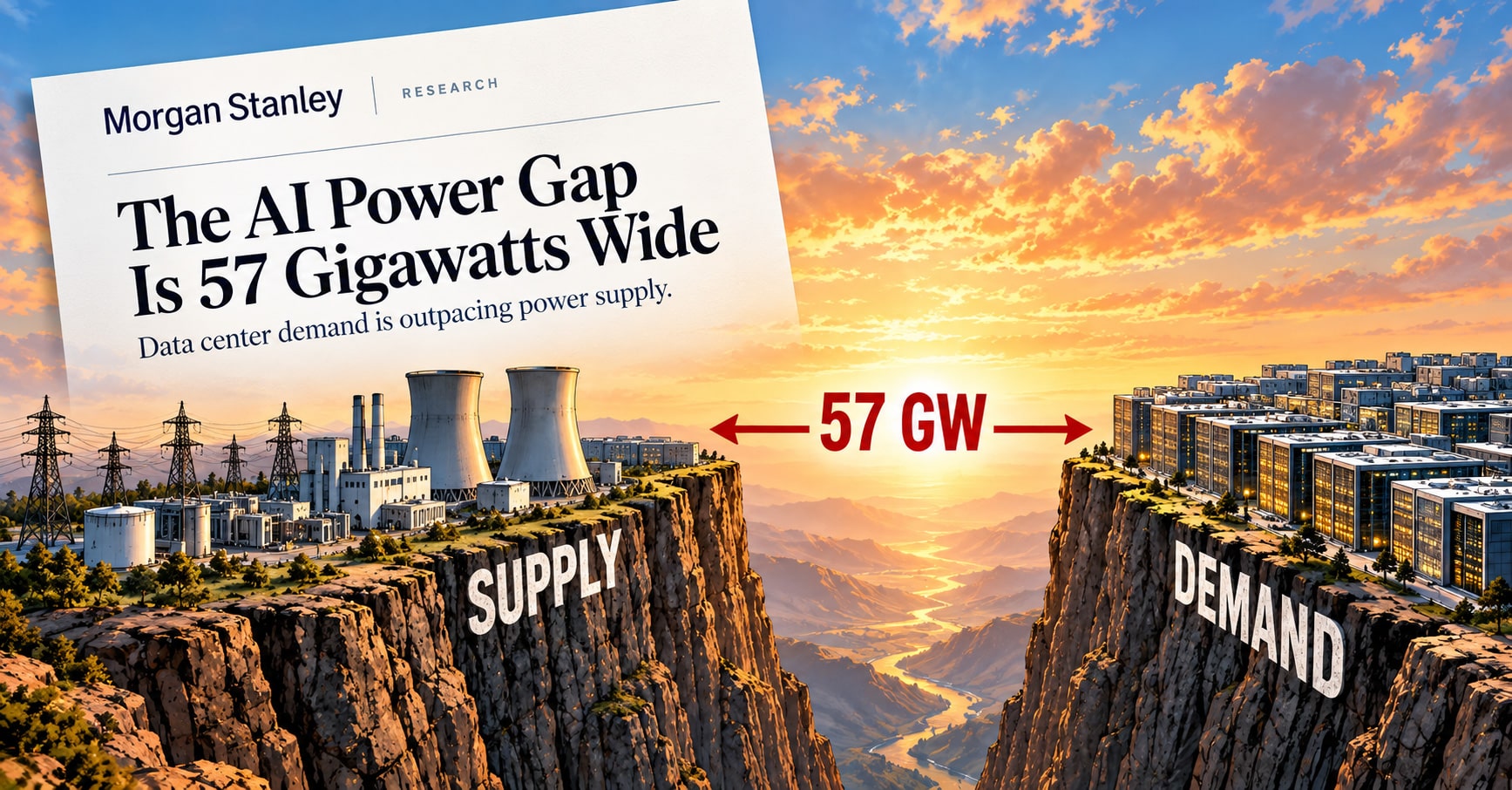

In Northern Virginia, the largest data center market on earth, a developer requesting a 100-megawatt grid connection today can expect to wait seven years for utility power, according to the 2026 JLL Global Data Center Outlook. The national average is four years. A modern data center shell, from groundbreaking to commissioned facility, typically takes 18 to 24 months to build. The math does not work. In most major U.S. markets, the building is finished years before the electrons arrive to fill it.
This is not a pipeline problem or a financing problem. Tech companies have committed over $650 billion in 2026 capital expenditure alone to build AI infrastructure. The projects are funded. The sites are secured. The buildings, in many cases, are already standing. The constraint is power, and specifically, access to it through a grid that was not built for the concentration of demand now being asked of it.
The scale of what is stalled is significant. More than $150 billion in U.S. data center projects were blocked or delayed in 2025. In the first quarter of 2026 alone, another $130 billion was added to that count. Lawrence Berkeley National Laboratory data shows more than 2,060 gigawatts of generation and storage capacity actively seeking grid connection, more than double the country’s entire installed generating capacity. ERCOT’s large-load queue stands at approximately 410 gigawatts, and data centers represent the majority of it. A campus that joins the Northern Virginia interconnection queue this year cannot realistically expect utility power before 2030 at the earliest.
Brennan Church, director of engineering, procurement and construction at data center developer Hut 8, put the situation plainly in Construction Dive: “A site can look perfect on paper, with strong land and fiber access, but if the utility cannot commit to a firm delivery timeline, the project stalls. What looks viable on paper usually breaks down on power, permitting or labor, and sometimes all three.”
The equipment situation compounds the queue problem. Large power transformers are on 2-to-4-year delivery schedules from most manufacturers. Medium-voltage switchgear is running 40-to-60-plus week lead times. Switchgear is sold out through 2028. A utility that approves a new substation today may not be able to physically build it until 2028, regardless of regulatory approvals. The equipment constraint is separate from the queue constraint, and it adds to it. A shell can be completed and mechanically roughed in, and it still cannot be energized.
The Workarounds and Why They Fall Short
The industry has converged on several responses to the power gap. Behind-the-meter natural gas generation is the most widely deployed: developers site turbines on or adjacent to the campus and operate on them while waiting for grid connectivity. The iMasons State of the Digital Infrastructure Industry 2026 Annual Report puts the capital cost at roughly $500 million for a 350-megawatt BTM deployment and notes that such installations require decades of operation to recoup the investment. Fuel cells are being deployed in some markets as a faster-to-install alternative, though they are limited in scale. Battery storage helps maximize whatever grid connection already exists but does not replace generation capacity.
These approaches share a common limitation: they are workarounds assembled under time pressure from a project team whose core competency is building data centers, not building power infrastructure. The BTM turbine approach, specifically, introduces secondary permitting tracks for air quality, emissions compliance, noise review, and community engagement, each capable of adding months to a project schedule and each requiring expertise that is distinct from data center construction. The iMasons report notes this explicitly, observing that turbine deployments are subject to entitlement processes that can rival the complexity of the underlying project.
Contractors have also responded to the power gap by raising the bar for which projects they will mobilize on. Firms are now explicitly prioritizing projects where power is already secured, and are pricing the risk of holding a completed shell without a fixed energization date. That dynamic further disadvantages projects with unresolved power situations: they cannot attract top-tier construction partners, cannot underwrite construction financing with confidence, and cannot give anchor tenants a credible commissioning date.
What NCP Brings to a Stalled Project
Next Century-Power was designed for exactly this situation. Not as a contingency, not as a bridging measure, but as the primary power solution for large-scale data center infrastructure that cannot wait for grid connectivity that may be a decade away.
Our Phase 1 infrastructure is large-scale gas turbine generation at 1 GW and above, deployed in islanded, single-tenant microgrid configurations. When we engage a stalled project, we bring the generation with us. We are not competing in the same transformer and switchgear queues as the utility, because we are not building a substation extension. We are building a dedicated power plant for a single customer, and we operate it as a managed energy partner, not as an equipment vendor. The project gets a committed megawatt delivery timeline, not a queue position.
The scale difference matters. The projects that are most severely stalled are the ones that need the most power: 200, 300, 500 MW campuses where a fuel cell array or a diesel generator farm is simply not a viable answer. NCP operates at the scale of those projects. A 1 GW+ gas turbine installation matches the power appetite of a genuine hyperscale campus, not a colocation suite. And because each installation is single-tenant and islanded, the customer receives dedicated capacity with no shared-grid curtailment exposure. There is no PJM emergency order that reaches an NCP-powered facility, because it is not a PJM facility.
Four-nines uptime targets, 99.99 percent availability with built-in redundancy, are the operational standard we design to. That exceeds what a grid-connected facility can typically achieve in constrained markets where, as we documented last week, a single fallen power line in Northern Virginia can pull 3.49 GW of data centers offline simultaneously. A facility that has never been on the shared grid cannot participate in that cascade.
On the environmental side, our on-site carbon capture system collects emissions and processes them into high-value 2D materials, addressing the air quality and sustainability concerns that complicate BTM turbine permitting for other operators. We have been through this process. We know how to move it.
What distinguishes NCP from a power company that simply shows up with turbines is the long-term trajectory. Our Phase 1 gas turbine infrastructure is the first chapter of a 30-year power relationship. Phase 2 is a 1.2 GW pod system of four integrated 300 MW small modular reactors, with carbon capture built in from the start, providing cost-stable, carbon-captured power at the contract horizons that genuine infrastructure investment requires. The iMasons report notes that commercially available advanced nuclear is five to seven years away from wider deployment. That timeline lines up almost exactly with our SMR roadmap. A developer who works with NCP today is not buying a band-aid. They are entering the power relationship that takes their facility from first energization through decades of stable, decarbonizing operation.
The data center industry is sitting on billions of dollars of stranded investment, projects that are otherwise ready to operate but cannot get power on a timeline that makes business sense. That gap has a name in our industry: it is called “Speed to Power.” It is also, not coincidentally, our tagline, because it is the problem we built the company around. We are already working to bring stalled projects to life, and the pipeline of projects that need exactly what we offer has never been larger. If you are managing a project that has run into the power wall, we would be glad to show you what the path forward looks like.
Source: How Long It Actually Takes to Power a Data Center in 2026, Construction Owners, July 2026; What’s Stalling Data Center Projects?, Construction Dive, April 2026; $130 Billion in AI Data Centers Blocked or Delayed in 2026, PR Newswire, July 2026; iMasons State of the Digital Infrastructure Industry 2026 Annual Report